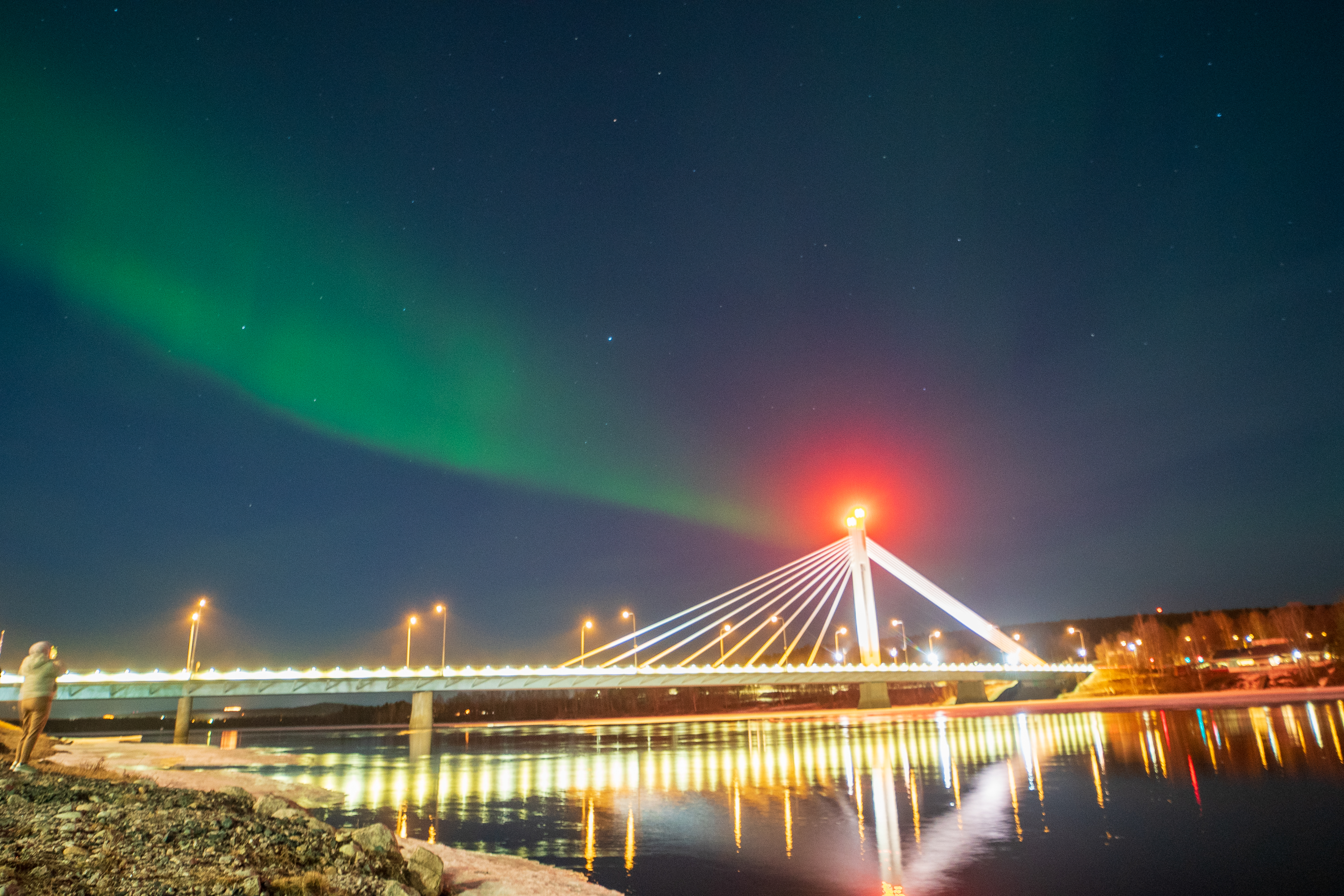
Will we still see the Northern Lights in the coming years?
Short answer: Yes.
Real answer: Yes, but differently — and at our latitude, possibly even better.
During the past months, we’ve been studying the Sun’s activity cycle and how it affects aurora hunting here in Rovaniemi. There’s a lot of misleading information out there right now, so we want to give you the full picture — not hype, not fear, just what we actually know.
 WHAT JUST HAPPENED
The Sun works in roughly 11-year cycles, swinging between high activity (solar maximum) and low activity (solar minimum). Solar Cycle 25 peaked in October 2024 — stronger than scientists expected — and we’re now in the declining phase heading toward a quieter period around 2029-2030.
 THE AURORA DOESN’T DISAPPEAR. IT CHANGES CHARACTER.
During solar maximum, the Northern Lights are mostly driven by CMEs — Coronal Mass Ejections. Think of these as massive explosions on the Sun that fling clouds of charged particles toward Earth. When they hit, they create huge geomagnetic storms that push the aurora far south. That’s why people in unexpected places saw the lights.
But these CME storms often produce high-altitude, diffuse aurora — lots of red and pink, spread across the sky, sometimes more like a glow than a dance.
As the Sun moves toward its quieter phase, a different engine takes over: High-Speed Solar Wind Streams (HSS) from coronal holes — large dark regions on the Sun where magnetic field lines open into space and plasma escapes freely.
And here’s what most people don’t know:
At high latitudes like Rovaniemi, HSS-driven aurora is often MORE vivid, MORE dynamic, and MORE alive than what we see during solar maximum.
 WHY THE “QUIET SUN” CAN PRODUCE SPECTACULAR AURORA
The physics behind this is fascinating.
HSS streams carry something called Alfvén waves — oscillating magnetic ripples that give Earth’s magnetic field repeated rapid pulses, like plucking a guitar string again and again. Each pulse triggers a burst of particles into our atmosphere, creating a substorm.
Instead of one sustained push (like a CME), you get a series of rapid energy releases. The result?
→ Fast-moving green arcs
→ Pulsing curtains that shift in seconds
→ Flickering rays and dancing pillars
→ Vivid greens and purples from oxygen and nitrogen at 100-150 km altitude
This is the “dancing” aurora. The kind that moves so fast you gasp. The kind that experienced photographers say produces some of their best images.
Experienced aurora watchers and scientists confirm this: some of the brightest, most dynamic aurora displays in recent memory happened during the LAST solar minimum (2018-2020) — not during the maximum.
 BUT THERE’S A CATCH — LOCATION MATTERS MORE THAN EVER
Here’s the trade-off: HSS-driven aurora stays closer to the auroral oval. It doesn’t spread far south like CME storms do.
That means:
 If you’re in London, Scotland, or northern Germany — yes, your aurora sightings will decrease in the coming years.
 If you’re in Rovaniemi, at 66.5°N, right inside the auroral oval — you’re in exactly the zone where this type of aurora is concentrated.
The band where HSS aurora is most active sits roughly between 66°N and 69°N. That’s us. Literally.
So while the headlines will say “Northern Lights are fading,” the reality is more nuanced: they’re fading for Paris and London. They’re not fading for the Arctic Circle.
 WHAT ABOUT THE LONG-TERM FUTURE?
Here’s something even most aurora guides don’t know:
The Sun doesn’t just operate on one 11-year cycle. There are deeper rhythms underneath:
→ The 22-year Hale Cycle (two sunspot cycles = one full magnetic reversal)
→ The 80-100 year Gleissberg Cycle (slow modulation of overall activity)
→ The 200+ year Suess/de Vries Cycle (grand patterns visible in ice cores and tree rings)
Solar Cycle 24 (the previous one) was the weakest in about 100 years. But Cycle 25 came back significantly stronger than predicted. The Sun’s polar magnetic fields are rebuilding faster than expected — and historically, that means the NEXT cycle (Cycle 26, starting around 2030-2031) could be even stronger.
In other words: we’re not heading into a long sleep. The Sun appears to be waking up over the coming decades. The aurora’s best years may still be ahead of us.
For us as tour operators, this means we can sometimes anticipate good aurora nights weeks in advance — not just hours.
 SO WHAT DOES THIS MEAN FOR YOUR TRIP TO ROVANIEMI?
The coming years will bring:
→ Aurora that dances faster and more vividly at our latitude
→ Stunning green and purple displays at lower altitudes
→ More predictable activity patterns from recurring coronal holes
→ Fewer crowds as casual tourists believe the “lights are fading” headlines
→ A more intimate, authentic Arctic experience
And when Cycle 26 arrives in the early 2030s? The show may get even bigger than what we’ve just experienced.
The Northern Lights aren’t fading. They will keep going!
—